
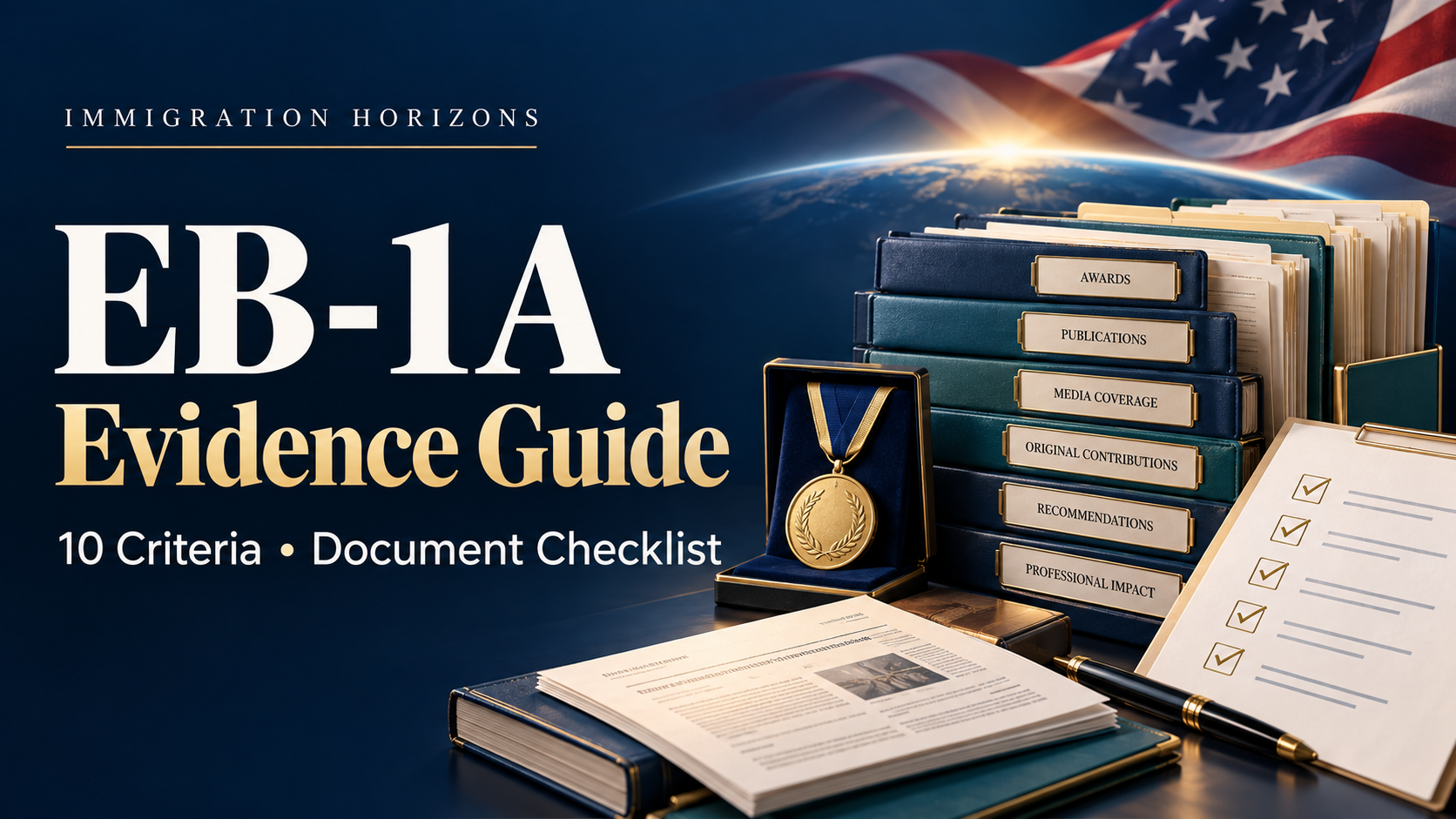
Preparing an EB-1A self-petition starts with understanding how your achievements connect to the extraordinary ability criteria. A résumé describes your career; an evidence collection provides records supporting particular claims. Organizing those records by criterion can help you identify what you have, what needs context, and what remains missing.
This guide explains the categories and suggests documents to gather for review. The examples are organizational starting points, not findings that a particular document satisfies a legal requirement. Immigration Horizons provides immigration paralegal and document preparation support for self-petitioners, without legal representation.
Understand the evidence framework first
The regulation provides an initial evidence route through a major internationally recognized award or evidence meeting at least three of ten criteria. It also requires sustained national or international acclaim. Meeting three categories does not, by itself, establish extraordinary ability: the broader standard concerns standing at the very top of the field. See 8 CFR 204.5(h).
Think of your preparation in two layers: organize records under the relevant categories, then assemble context explaining the achievements across your career. A folder containing three types of documents is not the same as evidence establishing three criteria.
The 10 EB-1A criteria and documents to organize
The following headings summarize the ten regulatory evidence categories. Suggested records beneath each heading are practical collection ideas, not mandatory document lists.
1. Nationally or internationally recognized awards for excellence
Gather award certificates, recipient announcements, selection rules, and background about the awarding organization. Keep the award year and category visible. Separate evidence identifying you as a recipient from information explaining the award’s recognition. Label nomination records accurately rather than grouping them with awards received.
2. Memberships requiring outstanding achievements judged by recognized experts
Collect membership confirmations, admission rules for your specific membership level, and information about the selection panel. Keep the rules applicable when you joined, if available. A useful organization question is: which record explains the achievements required for admission, rather than simply confirming membership?
3. Published material about you and your work
This category concerns professional or major trade publications or other major media. Save complete articles with their titles, dates, authors, and any necessary translations. Organize publication background separately. Mark passages discussing you and your work, while retaining the complete source for context.
4. Judging others’ work in the same or an allied field
Gather invitations alongside records documenting completed judging activity, such as review confirmations or panel participation letters. Record the subject evaluated, organizer, and date. Keep invitations awaiting completion in a separate folder so your inventory does not confuse an invitation with participation.
5. Original contributions of major significance in the field
Separate records describing what you created from records explaining its significance. Collection ideas include technical descriptions, adoption records, licensing documents, and specific third-party accounts of use. For each contribution, write a neutral inventory note identifying the contribution, your role, and the supporting document.
6. Authorship of scholarly articles
This category covers scholarly articles in professional or major trade publications or other major media. Gather complete articles, publication details, and author lists. Keep a bibliography linked to individual files. Separate articles you authored from coverage written about you; these are different evidence categories.
7. Display of your work at artistic exhibitions or showcases
Gather exhibition programs, catalogs, organizer confirmations, and records identifying the displayed work as yours. Record the venue and dates. USCIS’s October 2024 clarification explains that non-artistic exhibitions are considered only through a properly supported comparable-evidence claim, not directly under this artistic-display category.
8. Leading or critical roles for distinguished organizations
Collect role descriptions, organizational charts, employer letters, and records of specific responsibilities or results. Create a separate group for information about the organization’s reputation. This keeps two subjects distinct: what you did and the standing of the organization for which you performed the role.
9. High salary or significantly high remuneration compared with others
Gather compensation records and comparison materials relevant to your field. Label the year, currency, location, and compensation components. Keep base salary separate from bonuses or other payments. In your working notes, flag mismatched comparison periods or job categories instead of silently treating them as equivalent.
10. Commercial success in the performing arts
Organize box-office statements or sales records alongside documents identifying the production and your involvement. Label reporting periods and sources. Keep promotional announcements separate from financial results, and distinguish production-wide figures from payments made to you.
Build a clear evidence inventory
Before assembling a final document set, create a working inventory. The goal is traceability: another reader should be able to locate the record behind each factual statement without guessing.
- Assign an exhibit identifier: Use a consistent label for each document.
- Describe the record: Include its date, issuer, and relevant achievement.
- Record a possible category: Treat this as an organizational label, not a legal conclusion.
- Track missing context: Note incomplete pages, unavailable selection rules, or unclear authorship.
- Preserve sources: Keep complete originals separate from annotated working copies.
Where one document relates to multiple achievements, cross-reference it in the inventory rather than creating conflicting versions. Maintain a separate questions list for issues requiring legal assessment. Document organization and legal eligibility analysis serve different purposes.
Frequently asked questions
Do I need evidence for all ten criteria?
No. The regulation provides the major-award route or at least three criteria. That initial framework does not remove the broader extraordinary ability standard. Organize relevant evidence without assuming every category must apply.
What if the listed criteria do not fit my occupation?
The regulation permits comparable evidence when the standards do not readily apply to the occupation. This is not an automatic substitute for missing records. Keep proposed alternative evidence clearly labeled for legal review.
Does Immigration Horizons provide legal representation?
No. Immigration Horizons provides immigration paralegal and document preparation support for self-petitioners. Questions about eligibility, legal strategy, or whether particular evidence satisfies a criterion belong with a qualified immigration attorney.
Take the next step in organizing your documents
Start with an inventory of the records you already hold and a separate list of missing context. Keep achievements, supporting documents, and unresolved questions clearly connected. Contact Immigration Horizons to discuss document preparation support.